2024-08-20
Armoury I
In June of 2026, we started the Armoury editor project starting with a simple objective: develop a Markdown editor that provides developer centric functionality.
The ethos of Armoury was to support smart notes to assist you in exploring your trains of thought, and we ultimately landed on using Markdown Directives as a solution.
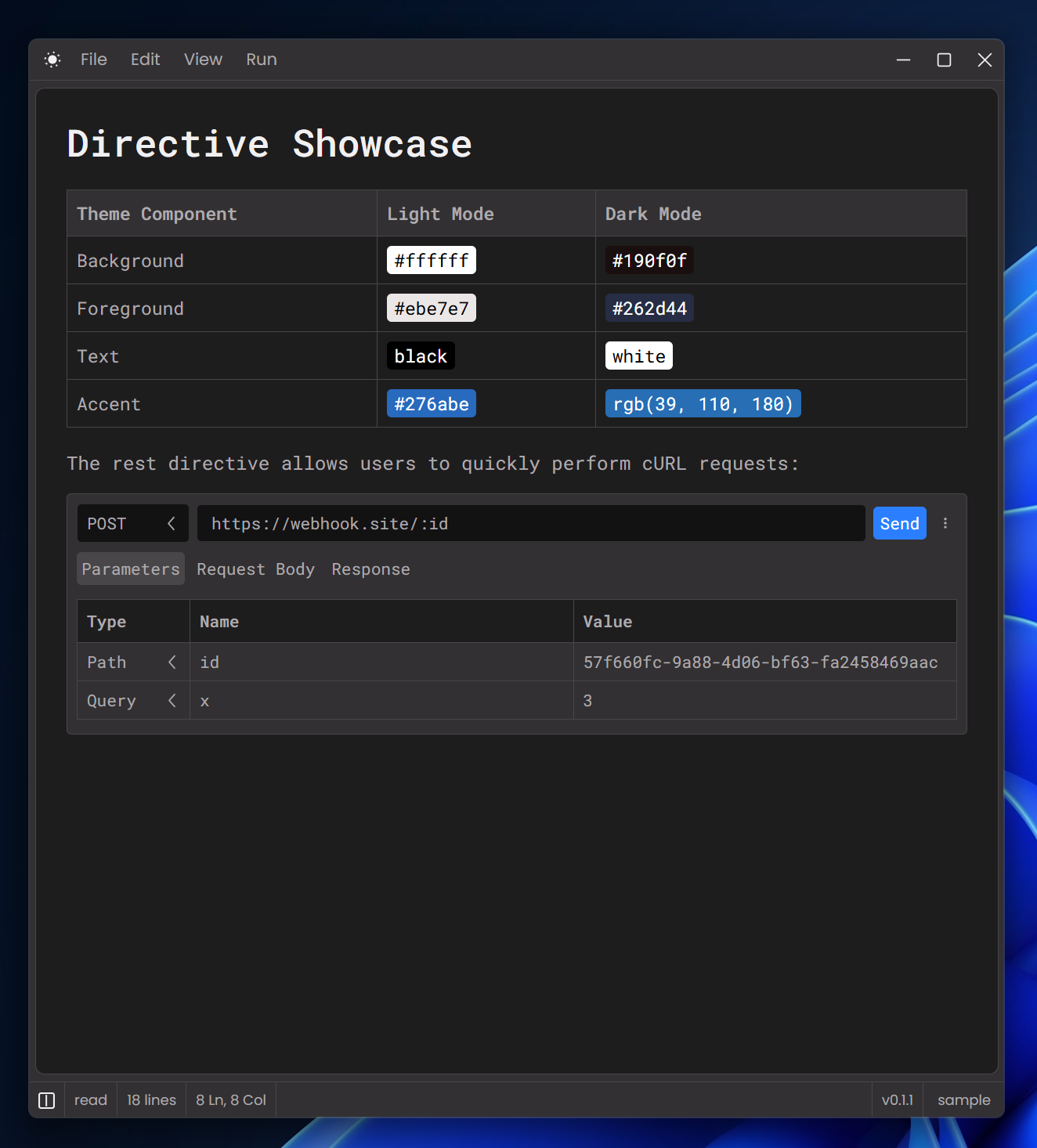 Armoury: Read Mode
You can find out more on the Armoury Home Page
Directives
Markdown directives do not have a fixed specification, and seems to have origined from this thread, as a potential method for extending markdown. Markdown directives support:
-
Inline directives that can be placed inside markdown blocks and paragraphs
1:name[children]{ #id .classA .classB param1 param2=foo param3="foo bar" } 2 -
Leaf directives that take up a whole line
1::name[children]{ #id .classA .classB param1 param2=foo param3="foo bar" } 2 -
Container or block directives that can have markdown inside
1:::name{ #id .classA .classB param1 param2=foo param3="foo bar" }
2valid markdown
3:::
4
Taking in CSS style classes and an ID, as well as keyword arguments and html children.
By adding directives to our markdown app, we could support an extension system where custom widgets could be used in notes. If a user wanted a handy utility to lay out the colour palette for the website they are designing, we added the :col directive, which provides a handy colour picker. If a developer wanted to quickly test an endpoint, we added the :::rest directive that provided an inline cURL tool (similar to Postman). The goal was to package the app with a wide array of conveniences and utilities.
Simplicity
Another key design philosophy we cemented early in our development was to maintain simplicity in note-taking. The goal of a notes app is to provide a user with a quick, reliable medium for projecting thoughts. The issue we took with market dominating platforms like Obsidian and Notion is the mental drain that comes with setting up your second brain.
The goal of a productivity tool should be to boost productivity, not to suck up essential time and mental resources in organising or inventing note-taking systems. Whilst Obsidian and more complex PKMs have their place, our mission was to provide a sleeker surface for users to blurt out their thoughts whilst actively solving problems.
The most important design choices we made to realise this goal was:
-
Ensure the app and notes load quickly and with as few steps as possible. Features such as the
Open Filepalette as well as preloading the most recently edited note helped achieve this. By also avoiding excessive bloat and needless dependencies, the app opens quickly with minimal friction. -
Require / provide as little configuration. The more a user can customise an application, the more it becomes a task onto itself. We will have opinionated features as the app should not become a project to be tweaked or worked on, distracting from the users pursuit. As a corollary to this, extensions should not allow users to restructure the flow of the app, only add new markdown components via the Directive system.
-
Minimal design; as few windows as possible (even fewer once live preview is implemented) and view one tab at a time.
Stack
The Armoury editor was developed using:
-
Wails v3 - a powerful cross platform app library that renders react via WebKit or WebView2 (windows). The project is still in Beta but is super cool.
-
The Golang programming language
-
React and Typescript for UI
-
React-markdown, Katex, remark and rehype for rich markdown support
-
CodeMirror6 for the editor